



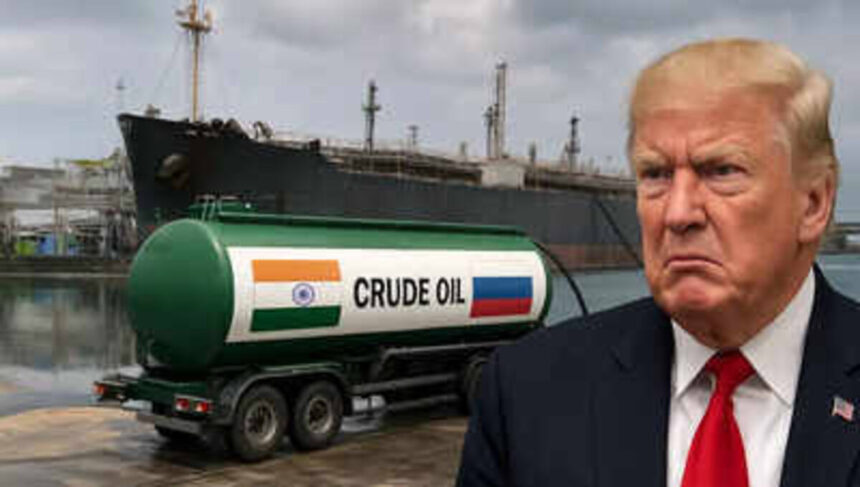
The Indus Zone Tech Desk | New Delhi, October 2025 |India Defends Russian Oil | The ongoing debate over India’s purchase of Russian oil has once again taken center stage in global discussions after former U.S. President Donald Trump commented that India’s cooperation could accelerate the end of the Russia-Ukraine war. Despite mounting Western pressure, India continues to assert that its energy imports are essential for maintaining global oil price stability.
Trump Urges India to Stop Buying Russian Oil
In a recent statement, Donald Trump remarked that India should reduce its dependency on Russian crude, suggesting that such a move could hasten the conclusion of the war in Ukraine. “If India doesn’t buy [Russian] oil, it makes [ending the war] much easier,” Trump stated. According to him, India assured that its purchases from Russia would decrease “within a short period of time” and resume only after the war ends.
Trump’s comments have reignited discussions about India’s balancing act between Western allies and its long-standing partnership with Moscow. Washington has often criticized countries that continue trading with Russia despite global sanctions. However, India maintains that its imports are strictly within the G7-imposed price cap and serve both national and international economic interests.
Brent Crude Prices Rise as Market Reacts
Meanwhile, global oil prices showed slight upward movement amid ongoing geopolitical tensions. On Thursday, Brent crude futures rose 0.82% to $62.43 per barrel by 10:31 p.m. ET, while U.S. West Texas Intermediate (WTI) futures increased 0.89% to $58.79 per barrel. The modest rise reflects persistent uncertainty about supply routes, global demand, and the political friction surrounding Russian exports.
At the Intercontinental Exchange in Europe, ICE Brent Crude (December 2025 contract) was recorded at $62.42, up 0.51 or 0.82% at 4:24 a.m. BST. These fluctuations indicate how sensitive the global market remains to developments in Russia’s energy exports and the policies of major importing nations like India and China.
India Among Top Buyers of Russian Crude
India has emerged as one of the world’s largest importers of discounted Russian crude since Moscow’s 2022 invasion of Ukraine. According to data from research firm Kpler, Russia exports around 3.35 million barrels of crude oil per day, with India purchasing about 1.7 million barrels and China around 1.1 million barrels.
This surge in Indian purchases has not only provided Moscow with steady revenue but has also allowed India to secure affordable energy amid global inflation. Analysts note that India’s refiners are benefiting from low-cost Russian crude, which they often process and re-export as refined products to markets including Europe and the United States.
New Delhi Defends Its Energy Strategy
Indian officials have consistently defended their decision to buy Russian oil, asserting that it aligns with the country’s economic and energy security needs. In an interview with CNBC in July, India’s Minister of Petroleum and Natural Gas Hardeep Singh Puri emphasized that New Delhi’s actions actually contributed to stabilizing global oil prices during a time of extreme volatility.
“If people or countries had stopped buying at that stage, the price of oil would have gone up to $130 a barrel,” Puri explained. “That was a situation in which we were advised, including by our friends in the United States, to please buy Russian oil — but within the price cap.”
This statement highlights the complex interplay between ethics, economics, and energy needs. India’s insistence on following the G7 price cap demonstrates an effort to comply with international frameworks while securing its domestic interests.
Understanding the G7 Price Cap on Russian Oil
Following Russia’s full-scale invasion of Ukraine in 2022, the G7 nations and the European Union imposed a price cap of $47.6 per barrel on Russian crude oil exports. The measure aimed to curb Moscow’s energy revenues and restrict its ability to fund the war while preventing a global oil supply shock.
The cap allows Russian oil to continue flowing into global markets but limits the price importers can pay, provided Western companies remain involved in insurance, shipping, or financial services. Countries purchasing Russian crude above the cap risk facing sanctions from the U.S. and its allies.
Balancing Global Diplomacy and Energy Security
For India, the issue is one of pragmatic diplomacy. The South Asian nation imports more than 80% of its crude oil requirements, making it highly sensitive to fluctuations in global prices. As the world’s third-largest energy consumer, India has prioritized securing affordable oil to sustain its economic growth and prevent inflationary shocks.
Energy analysts argue that India’s approach is neither ideological nor defiant but rather guided by the realities of energy dependence. “India’s primary concern is affordability and access,” said an energy expert from the Observer Research Foundation. “While the U.S. and Europe can afford to diversify rapidly, India’s options are more limited.”
U.S.-India Relations in Focus
Despite occasional tensions over energy policy, the U.S. and India continue to strengthen strategic and economic ties. The United States remains India’s largest trading partner, and both nations collaborate on defense, technology, and clean energy transitions.
However, Washington’s stance on Russian oil remains firm. The U.S. government continues to urge all countries to reduce financial flows to Russia, even as it acknowledges the practical challenges faced by developing economies like India. The Biden administration has also recognized India’s efforts to stay within the price cap and contribute to market stability.
Future of India’s Oil Trade
Looking ahead, India may gradually diversify its oil imports, but experts predict that Russian crude will remain a significant part of its energy mix in the near term. With competitive pricing and flexible payment arrangements, Moscow has become a reliable supplier amid volatile global markets.
India has also been exploring long-term contracts with Gulf nations and investing in renewable energy to reduce dependence on imported fossil fuels. Nevertheless, for now, Russian oil continues to play a crucial role in balancing affordability and availability.
Conclusion
The debate over India’s Russian oil imports reflects the broader complexities of global energy politics. While former U.S. President Donald Trump’s comments have reignited scrutiny, India stands firm on its position that buying Russian oil within the price cap helps stabilize global markets and serves national interests.
As the Russia-Ukraine conflict continues, and oil prices fluctuate between $58 and $63 per barrel, New Delhi’s balancing act between ethical diplomacy and energy pragmatism will remain one of the defining features of international oil trade in 2025.