


The Indus Zone Tech Desk | New Delhi, October 28, 2025 |The trial, aimed at inducing artificial rain to tackle air pollution in the capital.
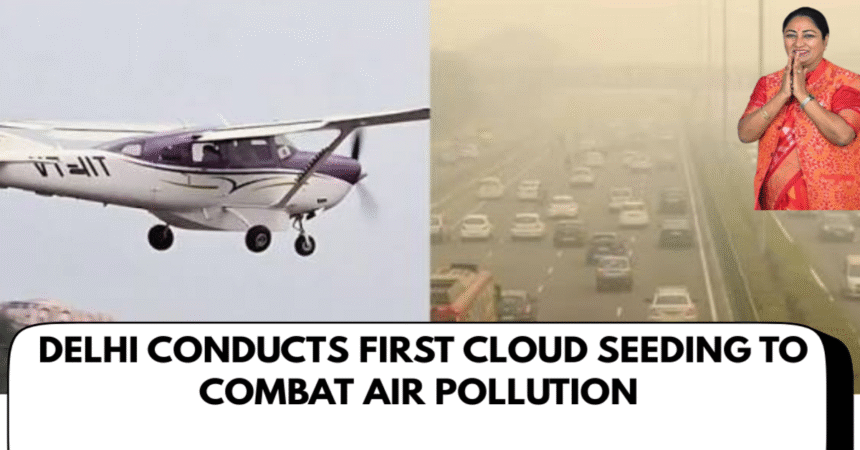
In a landmark move to fight rising air pollution levels, the Delhi government successfully conducted its first cloud-seeding trial in several parts of the national capital, including Burari and Karol Bagh, on Tuesday. The experiment aims to create artificial rainfall to help reduce toxic smog and improve air quality during the winter season.
Aircraft Takes Off from Kanpur for Delhi’s Cloud-Seeding Mission
According to officials, the specialized aircraft used for the operation took off from Kanpur and reached Delhi to conduct the first trial.
The cloud-seeding process involves dispersing certain chemical compounds, like silver iodide and sodium chloride, into the atmosphere to stimulate rainfall under specific weather conditions.
Delhi’s Environment Minister, Manjinder Singh Sirsa, confirmed that the first trial lasted about 30 minutes, during which eight fire flares were released into the targeted clouds. He added that, based on IIT Kanpur’s scientific model, rainfall could occur within 15 minutes to 4 hours after the cloud seeding is completed.
More Trials Planned Across Delhi
The government is planning to conduct multiple rounds of the artificial rain experiment over the next few days. The second trial is expected to take place later today in Outer Delhi, followed by at least nine additional trials across various zones.
These efforts are part of a larger pollution-control strategy launched by the Delhi government to combat severe winter smog, which typically worsens due to stubble burning, vehicle emissions, and low wind speeds.
Earlier Test Flight Faced Moisture Challenges
Before the official launch, the government carried out a test flight over Burari last week. During that run, small amounts of silver iodide and sodium chloride were sprayed from the aircraft to trigger precipitation.
However, experts noted that atmospheric moisture was only around 20%, far below the ideal level of 50% required for effective cloud formation. As a result, the test flight could not induce rain, though it helped calibrate the process for future trials.
Delhi’s Govt Plan to Curb Air Pollution with Artificial Rain
The cloud-seeding project is part of Delhi’s innovative steps to deal with dangerously high pollution levels, especially in the months of October and November, when AQI levels often reach “severe” categories. Artificial rain, if successful, could help wash away pollutants, settle dust, and temporarily improve air quality across the region.
Speaking about the initiative, Minister Sirsa emphasized that this collaboration with IIT Kanpur marks a major step toward scientific intervention in pollution control. “Our goal is to use technology to provide relief to residents during peak pollution periods,” he said.
What Is Cloud Seeding and How Does It Work?
Cloud seeding is a weather modification technique where chemical particles are released into the air to encourage cloud condensation and rainfall. The process requires specific humidity and temperature conditions to succeed.
The compounds used, such as silver iodide or sodium chloride, act as nuclei that attract water vapor, forming larger droplets that eventually fall as rain. This method has been successfully used in other countries like China, the UAE, and the United States for drought control and pollution reduction.
First Indian City to use artificial rain as an emergency
If the upcoming trials prove successful, Delhi could become the first Indian city to use artificial rain as an emergency tool against pollution.
Authorities believe that even light rain can significantly reduce smog density and improve visibility, offering much-needed relief to millions of residents during the city’s most polluted months.
The Delhi Environment Department, in partnership with IIT Kanpur, will continue to monitor the weather and conduct further experiments throughout the week. The results will help determine whether cloud seeding can be adopted regularly as part of Delhi’s long-term air quality improvement plan.
Key Highlights of cloud seeding process:
First cloud-seeding trial conducted over Burari and Karol Bagh on October 28, 2025.
Aircraft launched from Kanpur for Delhi’s artificial rain mission.
Eight fire flares released; trial lasted 30 minutes.
Second trial planned in Outer Delhi later today.
Nine additional trials scheduled in coming days.
Goal: Reduce pollution and smog levels in winter months.
Collaboration: Delhi Government and IIT Kanpur.