


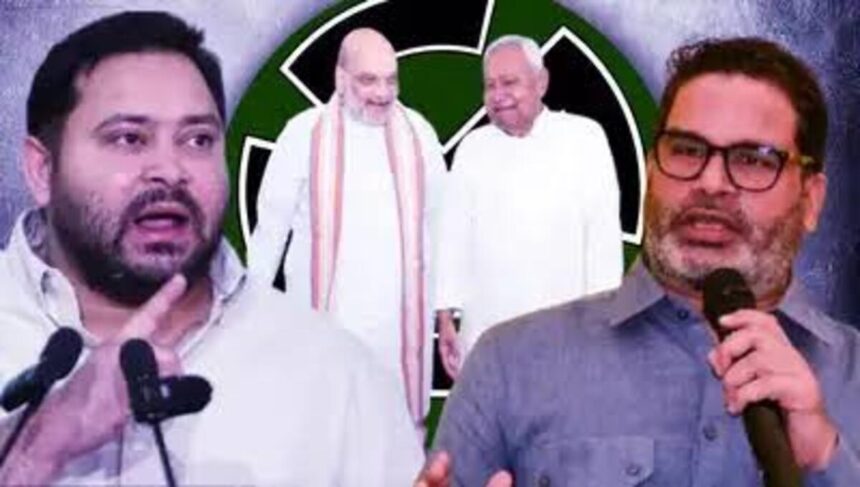
As Bihar gears up for the Assembly Elections 2025, the political scene in the state is heating up with growing tension, shifting loyalties, and power struggles within alliances. The Mahagathbandhan (Grand Alliance) — a coalition of RJD, Congress, and Left parties — is struggling to stay united amid serious disagreements over seat-sharing and candidate selection.
At the same time, Jan Suraj Party, led by former political strategist Prashant Kishor, is slowly making its presence felt, presenting itself as an alternative to both the NDA and the Mahagathbandhan.
The situation has created a mix of uncertainty and excitement among voters, as multiple political forces are now competing to shape Bihar’s future.
Seat-Sharing Deadlock in the Mahagathbandhan
The Rashtriya Janata Dal (RJD), Congress, and Left parties have failed to reach a final seat-sharing agreement even as the nomination deadline for the first phase of elections has passed. The first phase of polling will be held on November 6 across 121 constituencies in 18 districts.
This delay has led to confusion within the Grand Alliance. In several seats, candidates from the RJD, Congress, and CPI(ML) have filed nominations against each other — a move that could divide their votes and indirectly benefit the NDA.
The Congress, frustrated by the lack of coordination, has urged Tejashwi Prasad Yadav, the RJD leader and Mahagathbandhan’s coordination committee chairman, to resolve the issues quickly.
RJD Fields Candidate Against Congress President: Tensions Escalate
A major flashpoint came when the RJD decided to field a candidate against Congress state president Rajesh Ram in the Kutumba constituency in Aurangabad district. This move shocked Congress workers and further deepened the rift between the two allies.
Voting for Kutumba will take place in the second phase on November 11, and the Congress is reportedly reconsidering its strategy in a few constituencies after this open challenge from its main partner.
Congress Struggles to Manage Internal Rift
The Congress Party has released its second list of five candidates, taking the total to 53 candidates so far. However, many within the party are unhappy. Senior leaders like former MLA Gajanand Shahi and Chatrapati Yadav have publicly accused the leadership of favoritism and irregularities in ticket distribution.
This internal unrest has weakened the Congress’s image and added more chaos to the Grand Alliance’s campaign.
Left Parties Add to the Confusion
The Left parties, which were expected to play a supportive role in the Mahagathbandhan, have fielded candidates in multiple seats that were claimed by the Congress or RJD.
The CPI has nominated candidates from Rosera, Rajapakar, and Bihar Sharif, while the CPI(ML) has put up its own contender in Rajgir. In Begusarai’s Bachhwara seat, the Congress is contesting against the CPI’s candidate, and similar clashes are happening in Vaishali and Lalganj, where both Congress and RJD candidates are in the fray.
Such clashes clearly show that coordination between the allies is missing.
Smaller Parties Break Away
Adding to the Grand Alliance’s troubles, smaller partners are choosing to go solo. The Jharkhand Mukti Morcha (JMM) has decided to contest six seats independently, while the Indian Inclusive Party (IIP) has filed nominations from Saharsa and Jamalpur.
These developments suggest that the Mahagathbandhan’s base is weakening even before the campaign has fully started.
Jan Suraj Party: The Rising Third Force
While traditional alliances are busy managing internal fights, Prashant Kishor’s Jan Suraj Party is quietly gaining attention across Bihar. Known for his reputation as a political strategist, Kishor has been traveling extensively across the state, meeting people in villages and small towns as part of his “Jan Samvad Yatra.”
The Jan Suraj movement, which started as a social campaign, has now transformed into a full-fledged political organization. Kishor’s focus on education, employment, and local governance has resonated with many young and first-time voters who are tired of the same political promises from old parties.
Recently, Kishor announced that Jan Suraj will contest a significant number of seats in the upcoming elections, particularly in South Bihar and Seemanchal regions. He has also said that his candidates will be “clean and people-oriented,” aiming to give voters a new choice beyond the RJD, Congress, and BJP.
Political analysts believe that while Jan Suraj may not win a large number of seats this time, it could emerge as a vote-cutter for both the NDA and Mahagathbandhan, especially in urban and youth-dominated areas.
Tejashwi Yadav Faces His Biggest Test
Amid all this political noise, Tejashwi Prasad Yadav is facing the most challenging phase of his career. As the key face of the Mahagathbandhan, he now has to balance the growing demands of allies while also managing internal resentment within his own party.
Tejashwi’s campaign focuses on issues like unemployment, price rise, and corruption, but the alliance’s internal conflict is overshadowing his message. Political observers believe that if the seat-sharing issue is not resolved soon, the Mahagathbandhan could lose its edge before the campaign even peaks.
Nomination Process for Second Phase Underway
The second phase of nominations is currently in progress, covering 122 constituencies across 20 districts, with November 11 set as the polling date. The last date for filing nominations is tomorrow, and several constituencies are still witnessing multiple nominations from the same alliance, deepening the confusion among workers and voters alike.
Political Analysts Warn of Vote Split
Experts say that the ongoing disunity within the Grand Alliance could significantly impact its performance. “When allies compete against each other, it divides the voter base and gives an easy advantage to the ruling NDA,” says Dr. Anjali Pandey, a Patna-based political analyst.
Meanwhile, the Jan Suraj Party and independent candidates are expected to benefit from this situation. Many young voters have shown interest in supporting “new faces” instead of choosing between the same old political players.
Bihar Politics Latest Update
As of mid-October 2025, the NDA, led by Chief Minister Nitish Kumar and BJP, appears more organized and confident. The NDA has finalized most of its candidates and is already holding large rallies focusing on development, women’s safety, and law and order.
On the other hand, the Mahagathbandhan is still trying to finalize seat allocations, even as the first phase of polling draws closer. The Jan Suraj Party is expanding its base, especially in rural districts like Gopalganj, Champaran, and Siwan, where Prashant Kishor’s grassroots campaigns are drawing large crowds.
Political experts say that this time, Bihar may witness a three-way contest — between the NDA, Mahagathbandhan, and Jan Suraj Party — making the election results unpredictable.
Conclusion: Unity or Collapse for the Grand Alliance
The coming days will be crucial for the Mahagathbandhan. If leaders like Tejashwi Yadav and Rajesh Ram cannot resolve internal differences, the alliance risks a major collapse before the first vote is even cast.
Meanwhile, the Jan Suraj Party’s steady rise and the NDA’s organized strategy are reshaping Bihar’s political battlefield. The people of Bihar, who have seen decades of coalition politics, now await whether the Grand Alliance can regain unity — or if a new force like Jan Suraj will change the state’s political future.