


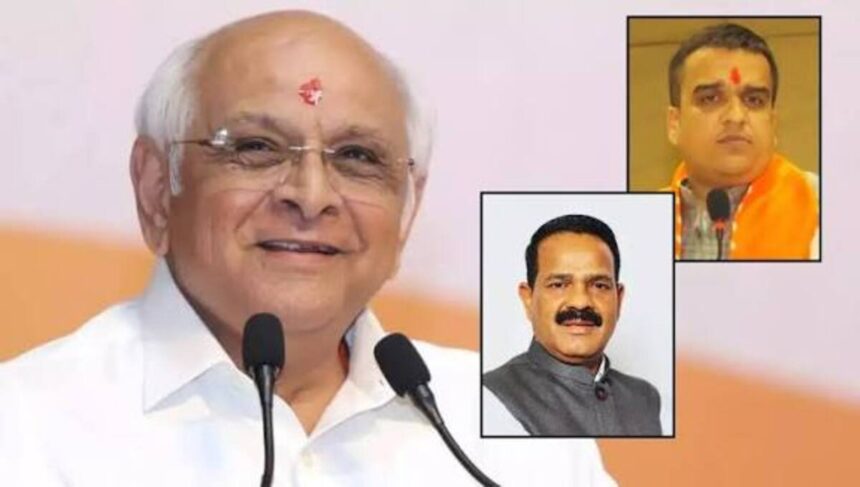
The Indus Zone Tech Desk | Gujarat Cabinet Reshuffle 2025 | Gandhinagar, October 16, 2025: In a bold political move, Chief Minister Bhupendra Patel has accepted the resignation of all ministers in his Gujarat government ahead of a long-anticipated Cabinet reshuffle. The entire council stepped down on Thursday, clearing the decks for a major expansion and restructuring of the state government, which will be officially announced on Friday, October 17, 2025.
According to senior officials, the swearing-in ceremony will take place at 11:30 a.m. at Raj Bhavan, Gandhinagar, where Governor Acharya Devvrat will administer the oath of office to the new ministers. Sources indicate that nearly half of the existing ministers could be replaced, making this one of the most extensive reshuffles of CM Patel’s tenure since he assumed office.
A Larger and Stronger Cabinet Structure
The current Gujarat cabinet consists of 17 members, including eight Cabinet-rank ministers and eight Ministers of State (MoS). However, the reshuffle is expected to increase the size of the council to 22 or 23 ministers, adding around 10 new faces to the lineup.
Under constitutional provisions, Gujarat, which has a 182-member Legislative Assembly, can have a maximum of 27 ministers—equivalent to 15 percent of the total strength. With this expansion, the BJP aims to balance representation from different regions, communities, and age groups while rewarding those who have performed well in the party and governance.
Focus on Youth, Performance, and Representation
One of the most talked-about names in the new lineup is Majura MLA Harsh Sanghavi, who currently serves as Minister of State for Home and Sports. Sanghavi is likely to be elevated to Cabinet rank, a move widely viewed as recognition of his administrative efficiency and his strong connect with the youth.
Another significant development is the expected induction of Rivaba Jadeja, the first-time MLA from Jamnagar North and wife of Indian cricketer Ravindra Jadeja. Her likely inclusion in the Cabinet marks her political debut at the state executive level. The BJP leadership’s decision to bring her on board underscores the party’s strategy of introducing fresh faces and diversifying representation to maintain its dominance in Gujarat politics.
Party insiders reveal that the reshuffle aims to strike a balance between experience and youth, with the inclusion of both seasoned leaders and first-time ministers. This approach is part of the BJP’s broader vision to prepare a new generation of leadership capable of taking Gujarat’s governance model to the next level.
A Calculated Political Strategy
The Cabinet overhaul comes shortly after Minister of State Jagdish Vishwakarma was appointed as the new BJP Gujarat state president, succeeding Union Minister C.R. Paatil. This change in the party’s organizational structure has paved the way for adjustments in the state’s administrative setup.
Political observers believe this reshuffle is a strategic move by the BJP to strengthen its grassroots leadership and correct any regional or community imbalances ahead of the 2027 Gujarat Assembly elections. The introduction of new ministers is also expected to boost administrative efficiency and bring in new energy and accountability within key departments.
Reshuffle Reflects Modi-Shah Political Blueprint
Chief Minister Bhupendra Patel, a trusted lieutenant of Prime Minister Narendra Modi and Union Home Minister Amit Shah, has been known for his low-profile yet efficient governance style. His government has emphasized infrastructure growth, industrial investment, and welfare schemes, positioning Gujarat as one of India’s top-performing states.
Sources close to the Chief Minister’s Office (CMO) suggest that the reshuffle reflects the Modi-Shah blueprint of performance-driven politics—where ministers are evaluated on merit, execution, and public connect rather than seniority alone. Those who have delivered strong results in their portfolios may be promoted, while underperformers could be dropped or reassigned.
Political and Administrative Implications
The upcoming swearing-in ceremony on Friday is expected to be attended by top BJP leaders from Gujarat and Delhi. The reshuffle is not just an internal exercise but a message of renewal and readiness as the state gears up for multiple challenges, including industrial expansion, employment generation, and rural development.
Observers note that the inclusion of new ministers like Rivaba Jadeja also serves a dual purpose — appealing to younger and women voters while enhancing the BJP’s mass outreach. The party has historically relied on a careful mix of experience, youth, and social representation to maintain its stronghold in Gujarat since 1995.
Background: Bhupendra Patel’s Tenure
Bhupendra Patel first took oath as Chief Minister in September 2021, following Vijay Rupani’s resignation. He led the BJP to a historic victory in the 2022 Assembly elections, taking oath for the second time on December 12, 2022. Since then, his administration has focused on key development sectors, including renewable energy, infrastructure, and investment-friendly policies.
This reshuffle marks a crucial phase in Patel’s second term, as he looks to inject new momentum into governance and reinforce BJP’s dominance in the state. The expansion also aligns with the central leadership’s efforts to keep Gujarat politically dynamic and electorally prepared.
What Lies Ahead
With around 10 new ministers expected to join, the reshuffle could reshape the power structure within Gujarat’s political landscape. Several district leaders and first-time MLAs are believed to be under consideration for ministerial roles.
The new cabinet is expected to reflect a balance of caste, region, and gender, signaling the BJP’s intent to maintain inclusivity and innovation in governance.
As the swearing-in ceremony approaches, all eyes are on CM Bhupendra Patel and the BJP high command to see who makes it into the new team. The move is being seen as a fresh beginning for Gujarat’s leadership, combining political stability with administrative agility to sustain the state’s growth trajectory.