



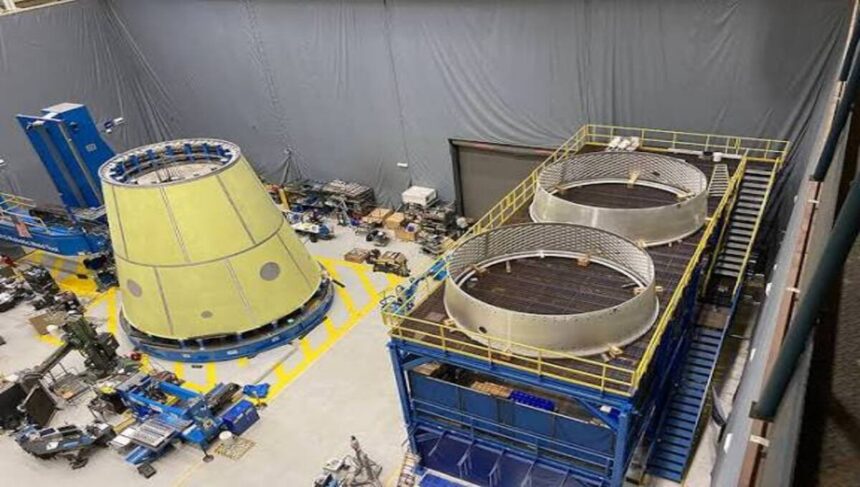
The Indus Zone Tech Desk | NASA Advances Artemis II Mission With Orion Stage Adapter Integration on SLS Rocket. NASA installs the Orion stage adapter on the Artemis II rocket, marking a key step toward the first crewed lunar mission under the Artemis program.
Focus Keyword: NASA Artemis II Orion stage adapter integration
NASA Takes a Major Step Toward Crewed Lunar Mission With Artemis II
NASA has reached another crucial milestone in its Artemis II lunar mission, successfully integrating the Orion stage adapter with the Space Launch System (SLS) rocket at the Kennedy Space Center in Florida. This achievement moves the agency one step closer to launching its first crewed mission to the Moon in over five decades — currently planned for April 2026.
The adapter, a critical structural component built by engineers at NASA’s Marshall Space Flight Center in Alabama, connects the rocket’s Interim Cryogenic Propulsion Stage (ICPS) with the Orion spacecraft. It also acts as a barrier, protecting Orion from hazardous gases during launch.
Connecting Science and Exploration
Beyond its primary structural purpose, the Orion stage adapter will play an important scientific role. It will carry and release four CubeSats, or small research satellites, into orbit. These CubeSats — developed by South Korea, Germany, Argentina, and Saudi Arabia — are designed to conduct space research and gather data about Earth’s orbit and deep-space environments.
Each CubeSat follows the 12U configuration, meaning it consists of 12 individual modular units, making them lightweight and efficient for space experiments. Once the Orion spacecraft reaches a safe distance from the SLS rocket, these CubeSats will be deployed into high Earth orbit to begin their missions.
“The integration of the Orion stage adapter marks a key technical achievement for Artemis II,” said a NASA official. “It demonstrates not only precision engineering but also international collaboration in space exploration.”
Preparing for the Next Stage of the Artemis Mission
With the stage adapter installation complete, NASA engineers are preparing to integrate the Orion spacecraft with the SLS rocket in the coming weeks. Following this, the Artemis II team will conduct system tests to ensure every component performs seamlessly before the scheduled launch.
Parallel to this progress, NASA teams are also working on hardware for Artemis III, the mission that will attempt to land astronauts on the lunar surface, including the first woman and the first person of color.
Artemis Program: Building a Sustainable Lunar Future
The Artemis program is central to NASA’s long-term goal of establishing a sustained human presence on the Moon and preparing for future Mars missions. By leveraging innovations in spacecraft design, propulsion, and international cooperation, NASA aims to create a new era of deep-space exploration.
The Orion stage adapter integration demonstrates NASA’s meticulous attention to detail and commitment to safety — key aspects of any human spaceflight mission. It also reflects how international partnerships are driving global participation in lunar research, a core value of the Artemis initiative.
Looking Ahead: Artemis II Launch Timeline
If all systems checks proceed as planned, Artemis II will carry four astronauts — including mission commander Reid Wiseman — on a 10-day journey around the Moon and back to Earth.
This mission will test life-support systems, communication technologies, and navigation capabilities essential for longer lunar surface missions.
The Artemis II flight will serve as a critical stepping stone toward Artemis III, where humans will return to the lunar surface for the first time since 1972.
Why This Milestone Matters
🔧 Engineering Excellence: The Orion stage adapter connects two major rocket components while safeguarding critical systems.
🌍 Global Collaboration: CubeSats from four countries highlight international partnerships in space science.
🌕 Future Readiness: Each successful integration brings NASA closer to sustainable Moon exploration and eventual Mars missions.
NASA’s ongoing dedication to precision engineering, research collaboration, and technological innovation is redefining the possibilities of human space exploration.